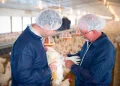



At a poultry farm near Tiflet, Morocco, Dr. Chemaou Tarik, owner of Aalaf Chemaou, reviews feed conversion ratios, efficiency, and animal performance. Numbers that define the bottom line. “I prefer U.S. soy in my broiler feed and see its impact on birds’ performance and flocks’ homogeneity,” he adds. His success is connected to soybean farms in the heartland of the United States, where multi-generational farmers are committed to delivering the best feed ingredient for customers across borders. The journey of these soybeans from the U.S. to Morocco shows the deep-rooted link of U.S. Soy in Morocco’s food and nutrition security.
Since the Free Trade Agreement (FTA) between the U.S. and Morocco was signed in 2006, Morocco has gained increased access to U.S. imports, making it the second-largest market for U.S. agricultural products in Africa. Its strategic geographic position also makes it an ideal hub for transshipment, connecting U.S. Soy to a wider regional market.

U.S. soybean meal is Morocco’s highest-value imported commodity, making Morocco the ninth-largest market for soybean meal globally. In the 2024/2025 marketing year, Morocco imported 512,000 MT of soybean meal, reflecting strong demand for U.S. Soy.
Powering Morocco’s Poultry
Poultry is Morocco’s most preferred source of animal protein, making it a key pillar of national food and nutrition security. With an expected annual growth rate of 5-7%, reliable, consistent, superior feed ingredients remain essential for sustained growth.
In 2024, Morocco produced 4.4 million tons of compound feed, 734,000 tons of poultry meat and 5.6 billion table eggs. The data is clear: poultry leads the nation’s protein demand.
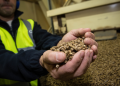
Poultry producers in Morocco recognize that feed ingredients such as U.S. Soy play an essential role in accelerating this growth. By choosing solar-dried U.S. Soy, customers benefit from the 4D’s, namely:
- Lower damage
- Drier soybeans
- Higher digestibility
- Zero deforestation compared to soy from other origins
These translate to improved animal performance, improved efficiency, and, in turn, higher profit potential.
Evolving consumer trends are also fueling demand. Higher-protein diets, a preference for processed poultry products, urbanization, e-commerce accessibility, and home delivery are reshaping Morocco’s consumption patterns, with protein playing a central role.

Sustainability: A Shared Vision
As Morocco progresses with its Generation Green 2020-2030 strategy, U.S. Soy’s lowest-carbon footprint and sustainable growing practices, such as no-till, cover crops, and reforestation, show shared values. By investing in sustainably verified U.S. Soybean meal, Morocco’s industry benefits from supply chain transparency and its commitment to sustainable agriculture. In marketing year 2025, Morocco imported 317,910 MT of SSAP-verified soy, including 137 MT of soybeans, 11,067 MT of soybean hulls, and 306,706 MT of soybean meal. Investing in SSAP-verified, sustainable U.S. Soy helps businesses achieve their sustainability targets and streamline ESG reporting.
U.S. Soy customers worldwide are leveraging U.S. Soy’s ‘Sustainable U.S. Soy’ and ‘Fed with Sustainable U.S. Soy’ labels to differentiate themselves in a global market increasingly prioritizing sustainability. To qualify for the label, customers must import 60% SSAP-verified U.S.-origin soybean meal or 90% for soy food products.
Beyond Poultry
With no domestic crushing currently in operation, Morocco relies on imports to advance its animal industry, driven by nutrition, sustainability, and a consistently reliable supply. While Morocco’s poultry industry is a dominant user of U.S. soybean meal, the dairy and aquaculture industries remain key users.
Aquaculture is expected to double production by 2030, increasing the need for sustainable aquafeed ingredients. The U.S. Soybean Export Council (USSEC)’s efforts have supported this growth through the introduction of the country’s first In-Pond Raceway System (IPRS), which boosts yield with minimal environmental impact.
“Our customers here in Morocco trust U.S. Soy with its nutrient-rich bundle,” added Khalid Benabdeljelil, USSEC Morocco Market Lead. “U.S. Soy’s consistently superior nutritional bundle assures our customers that they’re receiving the gold standard in market.”
Morocco’s dairy industry, one of the most prosperous in North Africa, also prefers U.S. soybean meal for its high quality, digestibility, and cost-efficiency. Beyond feed, Morocco is the largest importer of U.S. soybean oil in the Maghreb, highlighting the breadth of U.S. Soy’s value in the country.
Paving a Food-Secure Future Together
The growth of Morocco’s protein industry is built on three decades of partnership between U.S. Soy and Morocco. A Memorandum of Understanding signed between USSEC and The Poultry Federation of Morocco in 2024 further strengthened this collaboration.
“Morocco is a great case study in the convergence of favorable trade policy, quality preference and the alignment of relationships to a vision,” added Kevin Roepke, USSEC’s Executive Director. As Morocco’s protein industry continues to expand, U.S. Soy is the perfect partner to support long-term growth.
Related posts