
Understanding TMR stability and intake: why warm weather challenges are back in focus for dairy farms.
New research and the widespread adoption of precise data collection tools on dairy farms are reshaping how producers understand feed behaviour. Among the topics gaining renewed attention as nutritionists are preparing their spring rations is the impact of heat stress (HS) on dry matter (DM) intake and how this affects cow performance. In addition, far from being a seasonal curiosity, TMR heating is recognised as a year round management issue, showing clear evidence of reduced palatability and feed nutrient content. When warm weather coincides with feed heating, the challenge compounds, let’s see why.
Evidence shows rapid TMR deterioration is a common challenge
Field studies have highlighted how quickly TMR can deteriorate once exposed to air. Observations from 30 U.S. farms found that 50% of sampled rations showed signs of quality impairment in under 12 hours at 22°C (Kung, 2010). For many dairy operations, this means that even standard feeding routines—such as delivering feed twice daily—may not guarantee consistent freshness throughout the day.
The proliferation of temperature probes, rumination sensors, and intake monitoring systems has made it easier for producers to detect fluctuations that previously went unnoticed. As a result, TMR heating is becomng a more visible and quantifiable concern on modern farms.
Warm weather conditions affect cow behaviour and performance
Scientific literature clearly demonstrates that cows are sensitive to ambient conditions, often earlier than producers expect. Research indicates that heat stress may begin affecting dairy cows when temperatures reach 16–19°C, depending on humidity levels, corresponding to a Temperature-Humidity Index (THI) above 62. (Hammami et al. 2013)
Even moderate warm conditions can:
- reduce rumination time,
- depress dry matter intake (DMI),
- shift feeding behaviour toward cooler hours (during night),
- and ultimately decrease milk yield.
Importantly, up to 50% of the drop in milk production during warm periods is linked directly to reduced DMI (Dona, 2026, Ramnunas 2024).
Wild microbes: the bad bugs behind TMR heating cycle
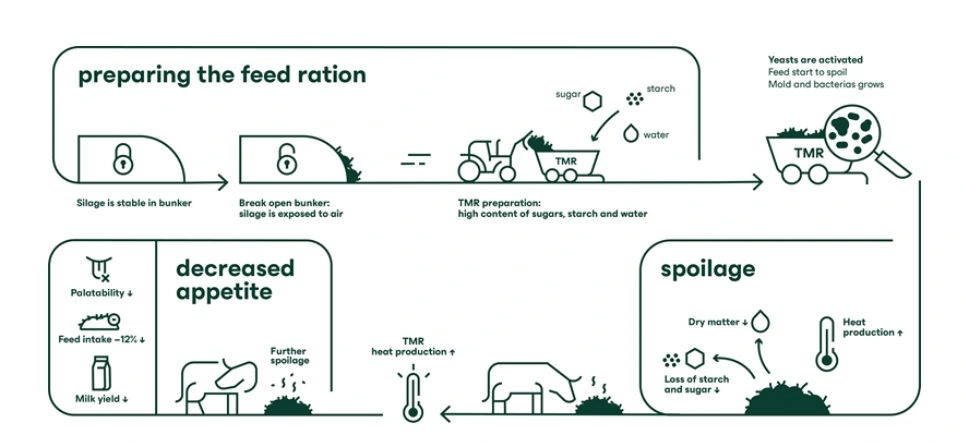
TMR heating is primarily a biological process driven by the activity of yeasts, molds, and bacteria. Once the silage face is opened and mixed in the TMR:
- Wild yeasts become active, using sugars and starch as substrates.
- Molds and aerobic bacteria will follow to proliferate.
- Microbial growth generates heat, causing feed temperatures to rise above ambient levels.
- This leads to measurable losses in nutrients, including dry matter, sugars, starch, and digestible fibre.
Warm feed: a nutritional and economic concern
VILOFOSS expert, Ventsi Marinov, explain us what he is observing on farm as TMR warms.
“I often look at the animal behaviour as a key indicator on how the farm is managed and how would I support this producer.
When the farmer reports changes and reduction of the intake, increasing of sorting and feed wastage, we can conclude that the nutrient delivery becomes inconsistent across the day and most of the time it translate at the milking parlor. Here depending on the farm situation, we can take a closer look at the TMR to see if I can suggest solutions. Its could include tips for management synergistically active with additives solutions.”
Groups fed less frequently—such as dry cows, heifers, or youngstock—are particularly vulnerable, as their rations may sit longer before consumption.
A new strategic focus for dairy producers
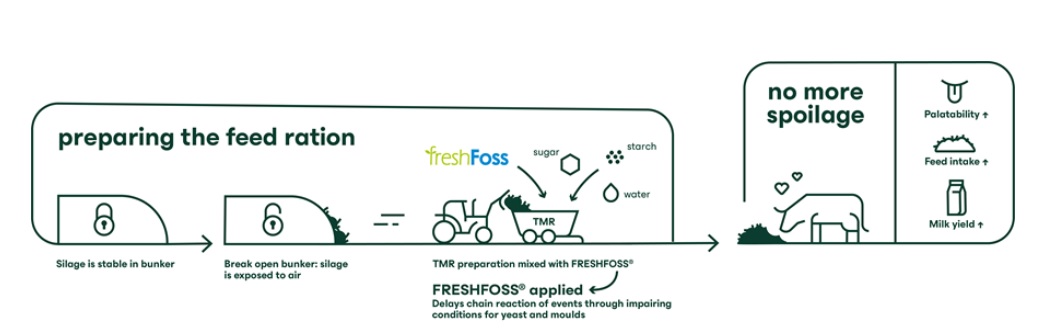
As farms gain more precise insight into feed temperature, cow behaviour, and intake patterns, TMR stability is emerging as a critical component of modern herd management. Among the solutions available, using TMR additive that can be added into the TMR mixing waggon is a time-saving solution to protect the feed.
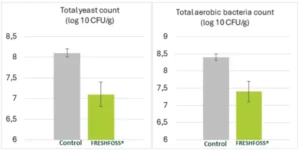
FRESHFOSS is a granulated solution coming from VILOFOSS expertise. It helps to stop the spoilage cycle in reducing the wild yeast and aerobic bacterial count versus non treated TMR (Kristensen,, 2019.)
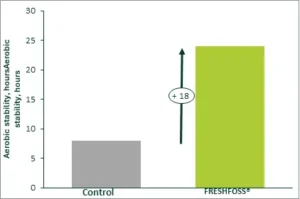
FRESHFOSS is also proven to increase aerobic stability by + 18h in controlled conditions (20°C) (Kristensen, 2019)). In an internal trial, FRESHFOSS improved TMR stability is translated maintaining nutrient content, higher total dry matter (+ 2.2%), higher starch and sugar content (+ 8g/kg TMR; + 14 g/ kg TMR) translated into improved Net metabilozed energy for milk production (Internal data).
 In a nushell, optimising TMR stability helps ensure:
- consistent nutrient intake across the day,
- improved rumen conditions,
- better resilience to warm weather periods,
and reduced feed losses. With feed representing one of the largest operating costs on dairy farms, preventing avoidable nutrient losses between mixing and ingestion has become an essential part of improving overall farm efficiency.
All the trial shown where conducted with dosage of 1 kg/T of TMR.
FRESHFOSS is not available worldwide, contact your VILOFOSS contact to know more about availability.
Related posts






To know more about intake and milk yield
DMI: a Key Driver of Milk Yield — Clear Evidence From Feeding Behaviour Research
Beyond the welldocumented effects of warm conditions on rumination and feeding patterns, research has consistently demonstrated that dry matter intake (DMI) is one of the strongest determinants of milk yield. A seminal study published in Livestock Science found that cows with higher milk production also consistently exhibited higher DMI and larger meal sizes, regardless of parity, and that feeding behaviour parameters such as meal duration and daily mealtime were strongly correlated with daily feed intake. The authors conclude unambiguously that “a high feed intake is essential to maintain high milk production, particularly during early lactation.”
This relationship highlights an important practical reality: anything that reduces DMI—whether behavioural changes due to warm weather, reduced palatability, or nutrient losses in the TMR—will directly depress milk yield. When warm conditions coincide with TMR heating, the impact is compounded. As the ration becomes warm due to microbial activity, cows reduce intake, exactly at a time when their physiological need for stable energy supply is highest. The result is a measurable and avoidable decline in both DMI and milk production.
For more information, please visit: https://www.vilofoss.com