



The long-term success of a dairy farm begins with the proper care and feeding of young calves. Every productive dairy cow starts its life as a healthy calf, and the management practices followed during the first few months play a crucial role in determining the animal’s future performance. Adequate nutrition during this early period supports rapid growth, strengthens the immune system, and prepares the calf for a productive life within the herd.For many years, dairy farmers have traditionally raised calves by feeding them whole milk obtained either from the dam or from the bulk milk produced on the farm. Although this practice has worked well historically, it may not always be the most profitable approach in modern dairy farming systems. Milk is a valuable product that generates income when sold in the market. When large quantities of saleable milk are diverted to calf feeding, the farm’s potential revenue is reduced.
To address this challenge, dairy producers increasingly rely on calf milk replacers—nutritionally balanced feeds designed to replace whole milk in calf diets. These products supply essential nutrients required for growth while allowing farmers to market more of their milk. When used correctly, milk replacers provide a practical and efficient solution for raising strong and healthy calves.
The Importance of Proper Nutrition in Early Calf Life
The period immediately after birth represents one of the most critical stages in the life of a calf. During the first few weeks, the animal experiences rapid physiological development, but its immune defenses and digestive capacity are still immature. Because of this vulnerability, calves require carefully managed feeding to ensure optimal growth and health.
Providing balanced nutrition during the early growth phase contributes to several important benefits:
- Accelerated body growth and improved weight gain
- Development of strong bones and well-formed muscles
- Enhanced resistance to infectious diseases
- Proper maturation of the digestive system
- Earlier onset of productive maturity in adulthood
If calves do not receive adequate nutrition during this stage, their growth rate slows down and their resistance to disease may be compromised. Such animals may require more time to reach maturity and often perform poorly as dairy cows later in life. Therefore, investing in proper calf nutrition is not simply a short-term management practice—it is a long-term investment in herd productivity.
What is Calf Milk Replacer?
Calf milk replacer is a carefully formulated powdered feed that is mixed with warm water and provided to calves as an alternative to whole milk. The product is designed to deliver all essential nutrients needed during the milk-feeding stage of a calf’s life.
High-quality milk replacers typically contain a balanced mixture of:
- Highly digestible protein sources
- Energy-rich carbohydrates
- Fat for concentrated energy supply
- Essential vitamins and minerals
- Functional additives that support digestion and health
These ingredients are combined in proportions that meet the nutritional requirements of growing calves while ensuring good digestibility.
Milk replacers are generally marketed in powder form. This format makes them easy to store, transport, and handle on farms. Before feeding, the powder is dissolved in warm water to create a liquid mixture that resembles natural milk in consistency and nutrient availability.
Nutritional Components of Calf Milk Replacer

A well-designed milk replacer contains several categories of ingredients that work together to support growth and health.
Protein Sources
Proteins are fundamental building blocks for the development of muscles, tissues, and organs in young animals. In milk replacers, proteins are obtained from both dairy and plant sources. Common ingredients include:
- Skim milk powder
- Whey powder
- Soy protein isolate
- Soy protein concentrate
- Wheat gluten
Among these, milk-derived proteins are considered highly digestible for young calves and are therefore widely used in premium milk replacer formulations.
Carbohydrate and Energy Sources
Energy is required for body maintenance, growth, and maintaining body temperature. The principal carbohydrate used in milk replacers is lactose, which is the natural sugar found in milk.
Some formulations may also include additional carbohydrate sources such as processed cereal derivatives or glucose-based ingredients to ensure adequate energy supply for growing calves.
Related posts






Fat Sources
Fats serve as an important source of concentrated energy in calf diets. They help support efficient weight gain and provide essential fatty acids that contribute to overall health.
Common fat ingredients used in milk replacers include:
- Coconut oil
- Palm oil
- Soybean oil
- Blended vegetable fats
Fats also facilitate the absorption of fat-soluble vitamins such as vitamins A, D, and E.
Vitamins and Mineral Supplements
Micronutrients are essential for maintaining metabolic functions, bone growth, and immune responses. To ensure balanced nutrition, milk replacers are fortified with several vitamins and minerals, including:
- Vitamin A for vision and immune development
- Vitamin D for bone development
- Vitamin E for antioxidant protection
- B-complex vitamins for metabolism
- Vitamin C for immune development
- Calcium and phosphorus for skeletal growth
- Trace minerals such as zinc, copper, iodine, and selenium
These nutrients collectively support the overall development and disease resistance of calves.
Functional Additives for Calf Health
Modern milk replacers often include specialized additives that promote digestive efficiency and intestinal health. Examples of such additives include:
- Probiotics, which introduce beneficial microorganisms into the gut
- Prebiotics, which support the growth of helpful bacteria
- Digestive enzymes, which improve nutrient utilization
- Essential amino acids, which enhance protein synthesis
- Emulsifiers, which improve fat digestion
These functional components help maintain gut health and reduce digestive disorders commonly observed in young calves.
Advantages of Using Milk Replacers in Dairy Farms
Increased Economic Returns
One of the most important advantages of milk replacer feeding is its contribution to farm profitability. Instead of feeding valuable whole milk to calves, farmers can market the milk and use milk replacers as a cost-effective alternative.
This practice allows dairy producers to increase income without compromising calf nutrition.
Consistency in Nutrient Supply
Natural milk composition can vary depending on factors such as the cow’s breed, stage of lactation, and health status. In contrast, milk replacers are manufactured under controlled conditions, ensuring that each batch contains consistent levels of nutrients.
As a result, calves receive a uniform and balanced diet throughout the feeding period.
Reduced Risk of Disease Transmission
Raw milk may sometimes carry harmful pathogens, particularly when cows suffer from conditions such as mastitis. Feeding contaminated milk can expose calves to infections.
Milk replacers are produced through controlled manufacturing processes and therefore reduce the likelihood of transmitting diseases through feeding.
Convenience in Storage and Handling
Another practical advantage of milk replacers is their ease of storage. Unlike fresh milk, powdered replacers have a longer shelf life and do not require refrigeration. This makes them convenient for farms managing multiple calves.
Improved Feeding Management
Milk replacers allow farmers to measure feed quantities accurately and maintain a consistent feeding schedule. Such control helps ensure that each calf receives the required amount of nutrients every day.
Feeding Management for Milk Replacers
Importance of Colostrum
The first feed given to a newborn calf is colostrum, the thick milk produced by the mother immediately after calving. Colostrum contains antibodies that protect the calf against diseases during the early stages of life.
Ideally, calves should receive sufficient colostrum within the first few hours after birth and continue receiving it during the first three days.
Starting Milk Replacer Feeding
After the colostrum-feeding period, milk replacer can be introduced gradually, usually beginning on the eighth day of life.
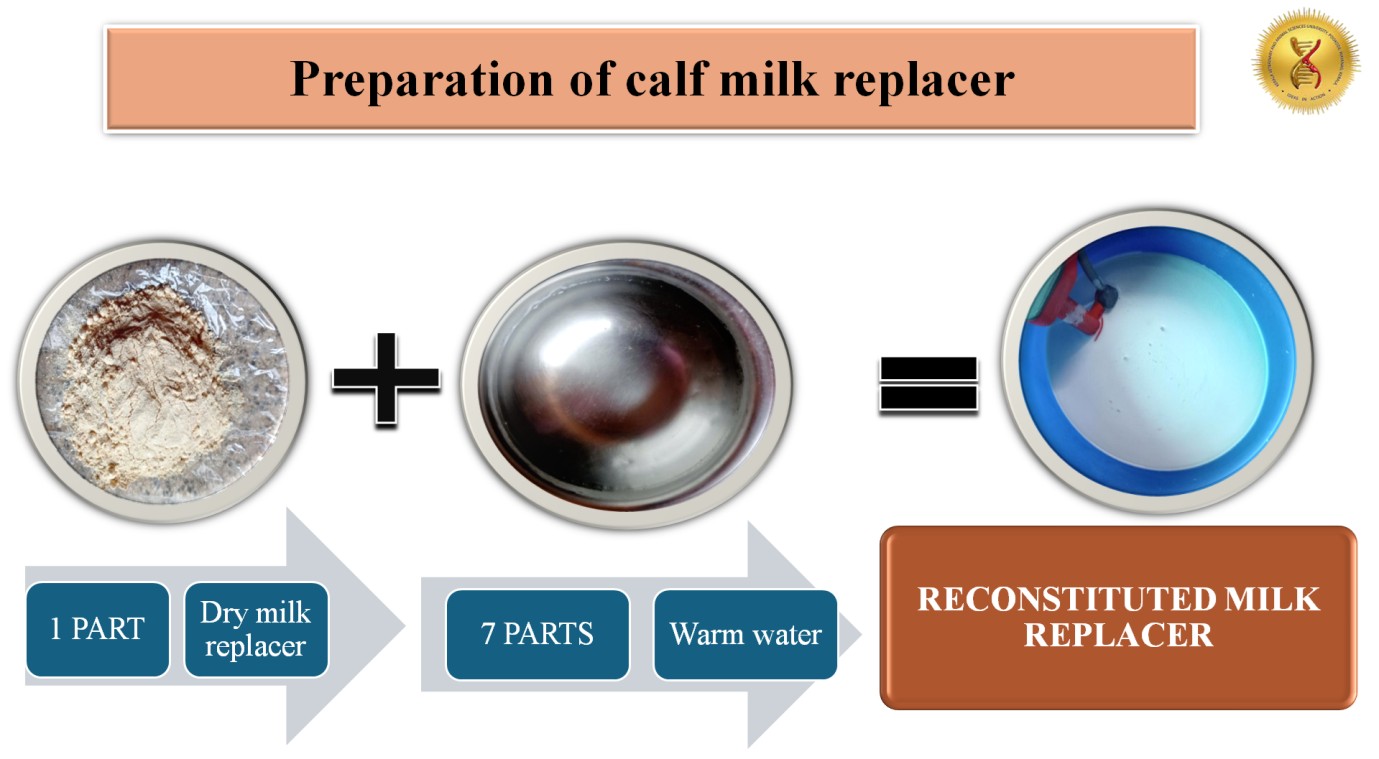
The powder is mixed with warm water, typically at a temperature of 40–45°C, to prepare the liquid feed. A commonly recommended mixing proportion is:
- 1 part milk replacer powder to 7 parts warm water
- Proper mixing ensures a uniform solution without lumps
Feeding Program for Dairy Calves
Although feeding schedules may vary slightly depending on farm management, a typical program may include the following schedule:
| Week 1-2 | Feed approximately 2–3 litres per day divided into two meals |
| Week 3-4 | Increase the quantity to around 3–4 litres daily |
| Week 5-6 | Provide about 4–5 litres per day depending on the calf’s growth |
| Week 7-8 | Gradually reduce liquid feeding to encourage solid feed intake |
| Week 9-10 | Begin the process of weaning from milk replacer |
Introducing Calf Starter Feed
While milk replacer supplies liquid nutrition, calves must gradually transition to solid feeds to develop a functional digestive system. Calf starter feed should be introduced at around two weeks of age.
Starter feeds stimulate the development of the rumen, the primary digestive chamber in adult cattle. Access to clean drinking water and small quantities of quality forage further supports rumen development.
Weaning the Calf
Weaning generally takes place between eight and ten weeks of age, once the calf begins consuming adequate quantities of starter feed. A gradual reduction in milk replacer feeding helps calves adapt smoothly to a solid diet.
Practical Feeding Tips for Farmers
Maintaining proper feeding hygiene and management practices is essential for raising healthy calves. Farmers should follow these guidelines:
- Use clean and safe water for preparing milk replacer
- Follow recommended mixing ratios carefully
- Feed the mixture at approximately body temperature
- Clean feeding equipment thoroughly after each use
- Prepare fresh feed before every feeding
- Observe calves regularly for changes in appetite or health
Simple management practices such as these can prevent many common health problems in young calves.
Conclusion
The future productivity of a dairy herd depends largely on the quality of calf management practiced on the farm. Proper nutrition during the early stages of life plays a vital role in raising strong and productive animals. Calf milk replacers provide a convenient and economically viable alternative to feeding whole milk. By allowing farmers to sell more marketable milk while still meeting the nutritional needs of calves, milk replacers contribute to improved farm profitability. When combined with good hygiene, balanced feeding programs, and careful management, milk replacers can help dairy farmers raise healthier calves and build more productive herds for the future.